Over the past week, Michael Burry—the legendary figure behind The Big Short—has resurfaced at the center of market conversation. His recently disclosed short position against major tech names triggered a brief pullback across the sector. Yet the swift recovery that followed suggests investors were responding more to his reputation than to any shift in fundamental conditions.
In fact, the episode highlights a broader point: Burry’s expertise lies in uncovering structural distortions, not in navigating high-growth technology cycles.
Historical Context: A Track Record That Doesn’t Translate to Tech
While Burry’s macro warnings are often treated with reverence, his calls on the technology sector have been notably inconsistent.
Three to four years ago, he shorted Tesla and the Nasdaq—both trades ultimately ended in losses.
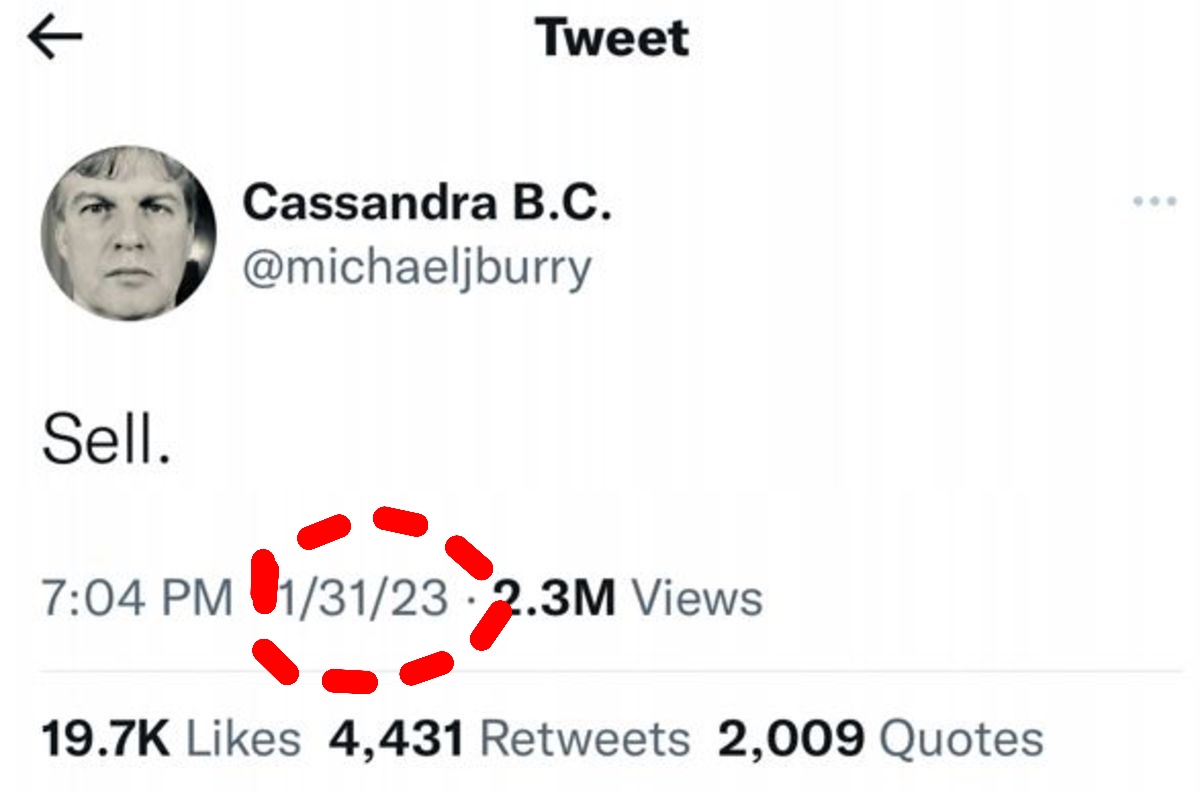
In early 2023, he posted the now-famous “Sell Everything,” just as the market began a multi-year rally that has nearly doubled since.
These examples don’t diminish his analytical skill; rather, they reveal an important distinction:
Burry excels at identifying systemic mispricings, but the current tech cycle is not built on the same mechanics as the 2008 credit crisis.
The dynamics driving today’s market—AI infrastructure demand, capital expenditure cycles, compute economics, and liquidity—are far removed from the mortgage-backed securities world where his framework shined.
Last Week’s Pullback: A Technical Clean-Up, Not a Fundamental Shift
The volatility following Burry’s announcement looked dramatic, but its underlying drivers were familiar:
A steep, concentrated run-up in AI-linked names
Profit-taking by momentum-heavy funds
Macro uncertainty surrounding government budget gridlock
A convenient narrative for short-term sentiment
These forces converged to create a textbook technical correction.
The rapid rebound that followed confirms that:
The market did not meaningfully adopt Burry’s bearish thesis.
Liquidity support remains intact, institutional demand for AI-related exposure remains strong, and positioning suggests investors still view compute infrastructure as the dominant beta trade of this cycle.
The Depreciation Debate: A Narrow Reading of Compute Economics
Burry’s latest argument centers on claims that tech giants are artificially extending GPU depreciation schedules—reporting a six-year useful life for hardware he believes lasts only three.
The issue is more nuanced than that.
-
GPU hardware life meaningfully exceeds three years.
Over the past five to six years, performance per watt has improved gradually, not dramatically.
Older GPUs—such as the widely used 3090—continue to run training and inference workloads reliably across numerous labs, particularly in Asia. -
Depreciation schedules reflect asset value decay, not physical lifespan.
The economic usefulness of a GPU is tied to workload demand, model optimization, and cluster efficiency—not simply the date of manufacture. -
GAAP and IFRS offer broad flexibility based on operating context.
Companies with different workloads, redundancy requirements, and data center designs naturally adopt different depreciation assumptions.
Six years is neither unusual nor indicative of manipulation.
Framing the issue as a profit-inflation scheme oversimplifies compute economics and misunderstands how AI infrastructure is actually utilized.
More importantly, it diverts attention from the real drivers of earnings in this sector: unit demand, utilization, and the scaling curve of AI workloads.
Market Structure: Rallies Are Defined by Liquidity, Not Headlines
Strip away the commentary, and market structure offers a clearer explanation for recent price action.
A sustained rally requires only two ingredients:
Concentrated inventory in strong hands, and
A steady supply of buyers willing to take prices higher.
Under these conditions, straight-line appreciation is neither realistic nor desirable.
Healthy rallies always exhibit periods of volatility—profit-taking, shakeouts, and narrative conflict.
These moments reset positioning and strengthen the underlying trend.
Viewed through this lens, last week’s dip was not a warning sign of systemic fragility.
It was a necessary period of price discovery, amplified by the attention surrounding a high-profile investor.
Conclusion: Insightful Voices Matter—But Market Structure Matters More
Michael Burry remains an important and often prescient thinker.
His ability to identify hidden fragilities is exceptional.
But no investor is universally accurate across all domains, and the technology sector operates on a fundamentally different playbook than the one he mastered in 2008.
Today’s market is driven by:
AI-driven compute demand
Capital expenditure cycles
Cloud provider economics
Global liquidity and positioning dynamics
These factors—not a single investor’s viewpoint—are what ultimately determine the trajectory of tech assets.
For investors, the more relevant questions are:
How sustainable are AI capital expenditures over the next 24–36 months?
What does the marginal return on compute look like as models scale?
Where are the true bottlenecks in the global supply chain for GPUs, power, and networking?
How quickly will enterprises integrate AI into revenue-generating workloads?
The answers to these questions—not short-term commentary—will dictate the next phase of this cycle.

