Ever since AlphaMind AI went live, many users have asked us the same thing:
How do you generate so many trading signals that can stay consistently profitable?
The answer isn’t mystical. It isn’t “intuition” or “luck.”
It comes from the same underlying logic that drives modern hedge-fund quant research—combined with the capabilities of AI.
So today’s article is about that logic:
What kinds of data can an AI-driven quant system actually learn from?
The Reality: What Retail Traders See vs. What Real Quant Funds Use
When people think of traders, they usually picture flashing candlestick charts, a cluster of technical indicators, and a couple of monitors stacked together.
But in a true quantitative firm, those charts are closer to toys than tools.
Walk into the offices of Two Sigma or Citadel and you won’t see a wall of candlesticks.
You’ll see:
Satellite images showing parking-lot occupancy
Real-time positions of container ships
Millions of anonymized credit-card transactions
GitHub commit activity from SaaS companies
This is the world of alternative data.
For top quant funds, public market prices and financial statements make up less than 5% of the information they use.
The other 95% comes from everything that’s messy, unstructured, and difficult to process: satellite images, web traffic, logistics data, text sentiment, IoT sensor feeds, statistical anomalies—anything that can reflect real economic behavior.
Why Does Quant Need Alternative Data?
Because traditional data—prices, volume, financial statements—has been fully exploited.
This is the essence of market efficiency: if everyone builds models on the same information, all alpha eventually disappears.
A top quant researcher’s job is simple (but incredibly difficult):
Find signals that reveal real-world economic activity before everyone else can see it.
For the past decade, only the world’s top hedge funds had the capability to do this.
But as AI capabilities exploded, some tools have begun to democratize.
AlphaMind AI is built around that exact idea:
combine quant logic with modern AI, and make it accessible to everyday traders.
Of course, elite quant funds still operate at a scale that retail users cannot reach.
But technology is changing how quickly market transparency spreads.
Why Traditional Price-Based Signals Don’t Work Anymore
Markets are extremely complex and nearly impossible to predict using simple tools.
A candlestick only reflects past movement.
Price is a result variable—rarely the cause of future moves.
Traditional price/volume-based factors have been used so extensively that they no longer provide sustainable alpha.
If someone tells you they “consistently beat the market” just by reading charts, they’re almost certainly selling a story.
Alternative data has value because it offers two advantages:
- Scarcity — You have data others don’t.
- Complexity — You can structure data others don’t understand.
Under this logic, things like parking-lot images, supply-chain speeds, employee sentiment on Glassdoor, or even the flight route of a CEO’s private jet can reveal real business activity weeks before earnings reports.
The core of quant investing is to find these leading indicators.
How Quants Turn Messy Data Into Alpha
Models like Bayesian inference, Kalman filters, graph networks, and complex time-series frameworks can take thousands of weak relationships and fuse them into strong signals.
In AlphaMind’s short-term market analysis module, you’ll see a simplified version of the same idea:
AI blends statistical models, macro trends, liquidity flow, technical cycles, and news sentiment to generate trend forecasts and risk warnings in a form that normal traders can understand.
Two Sigma reviews over 10,000+ alternative datasets every year—but fewer than 1% ever make it into production.
Citadel relies heavily on microstructure data from its market-making operations—data retail traders can never truly access.
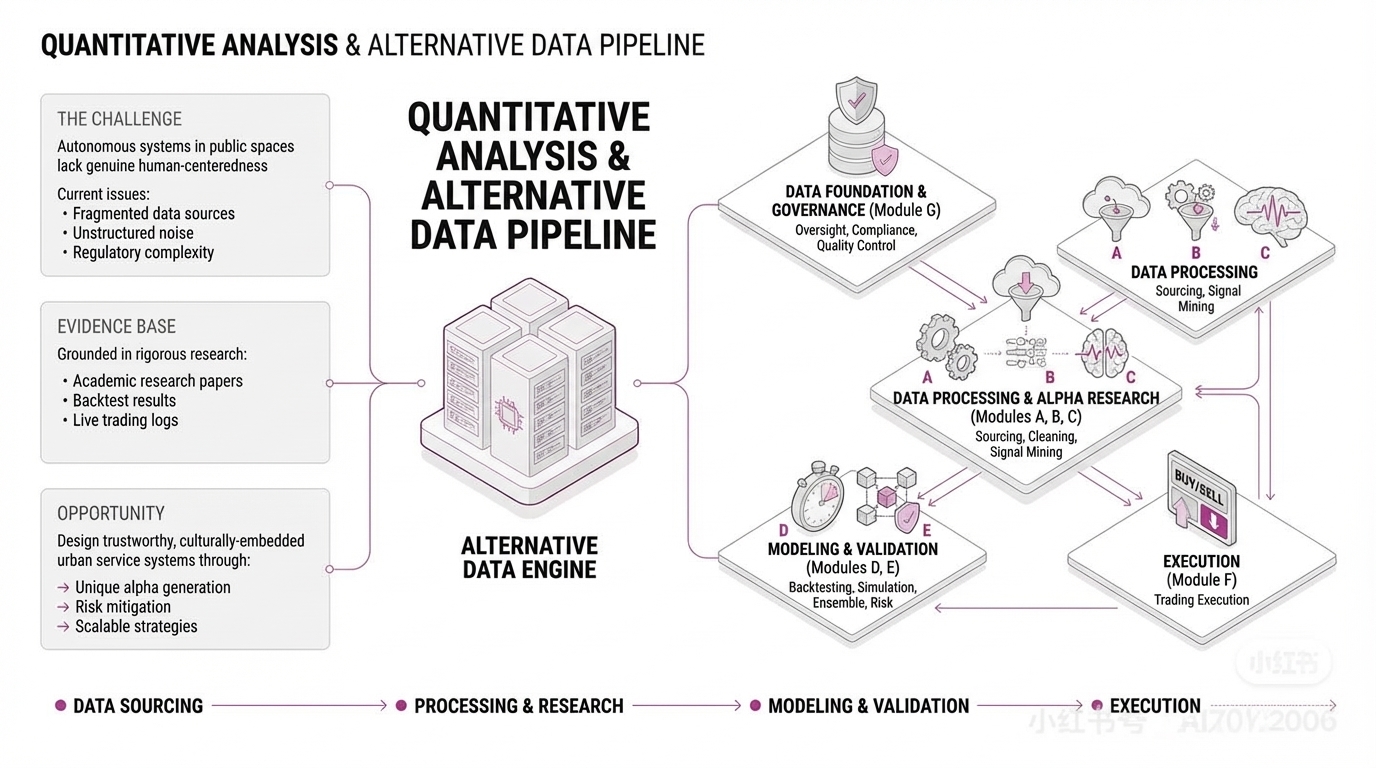
How Top Hedge Funds Extract Value From Data: The Seven-Module Pipeline
Elite quant funds turn raw information into trading signals through a specialized workflow.
Here is how the process works:
Module A: Data Sourcing
Two Sigma has a dedicated Alpha Capture / Data Sourcing team whose job is to scour the world for data:
Meeting vendors at industry conferences
Partnering with satellite companies
Building internal web crawlers
Exchanging datasets with SaaS platforms
Purchasing global statistics
Analyzing GitHub and Reddit activity
Using AI to autonomously search for commercializable data
Every dataset is judged across six dimensions:
uniqueness, timeliness, coverage, frequency, noise ratio, and compliance.
Only a tiny fraction passes through.
Module B: Data Cleaning & Engineering
The hardest part of alt-data isn’t trading it—it's cleaning it.
Quants perform:
Automated anomaly detection
Web-structure change monitoring
Bot/user identification
Outlier filtering
Time alignment across different sources
Entity mapping across tickers, regions, SKUs
Missing data is a huge challenge.
Two Sigma often uses hybrid time-series + ML methods to maintain continuity.
At AlphaMind, we’ve encountered many of the same issues—financial text ambiguity, asynchronous price feeds, noisy headlines.
This is why we invested heavily in AI-driven automatic denoising and structuring.
Module C: Alpha Research
This is no longer “build a factor.”
It’s a full scientific pipeline.
Examples:
Hiring growth → R&D expansion → future profit acceleration
Parking lot traffic → same-store sales prediction
Night-time light intensity → GDP growth forecasts
Shipping-route changes → commodity demand shifts
Then come machine-learning models:
Gradient boosted trees
Random forests
XGBoost
Graph neural networks
LSTM and Transformer time-series models
AlphaMind’s predictive signals follow a similar multi-factor philosophy, but use public data plus generative AI explanation layers to make outputs readable for everyday traders.
Module D: Signal Validation
No dataset can be traded immediately.
Quant firms validate in three stages:
Long-horizon backtests (10+ years, cross-market, cost-adjusted)
Synthetic stress tests (noise injection, partial deletion, adversarial scenarios)
Production simulation (paper trading)
Citadel’s simulation engine can even replicate real counterparty behavior and market impact.
Module E: Model Integration
A usable signal must coexist with hundreds or thousands of other signals.
Integration involves:
Layered model structures
PCA or dimensionality reduction
Bayesian averaging
Cross-signal correlation checks
Liquidity and capacity constraints
Exposure and risk monitoring
Module F: Execution
For quants, execution is arguably the most important part.
Smart order routing
Dark-pool optimization
Latency engineering
Market-impact modeling
Microwave/optical network routing
Tick-by-tick feedback
Execution is a competitive battleground.
Module G: Data Governance
Alternative data carries legal and operational risk.
Institutions track lineage, assign dataset IDs, monitor updates, and maintain strict anonymization policies.
Examples of Alternative Data in Action
Satellite imaging: Parking-lot traffic predicts Walmart earnings; tank-shadow geometry estimates crude inventory.
Shipping & supply chain data: AIS signals track global commodity flows.
Credit-card & receipt data: Real-time sales trends for Netflix, Starbucks, Lululemon.
Corporate jet tracking: CEO flight routes hint at M&A activity.
Glassdoor sentiment: Employee dissatisfaction warns of management issues.
Reddit/Twitter sentiment: Retail mania indicators for short-squeeze risk.
Microstructure data: Order-book patterns reveal high-frequency opportunities.
These allow hedge funds to understand a company’s condition months before earnings.
Why Retail Traders Can’t Simply Do This
If the data is purchasable, why can’t retail traders replicate it?
- Data cleaning is brutally hard.
Satellite images are raw; card-data is biased; text data is chaotic.
Top funds sometimes devote 50%+ of their manpower to engineering—not modeling.
- Costs are enormous.
High-quality datasets can cost hundreds of thousands to millions per year.
- Backtesting traps.
Many datasets contain “look-ahead bias.”
For example, a satellite image might appear to be timestamped at noon, but processing delays mean it wasn’t actually available until several days later.
Institutional Point-in-Time databases prevent these errors; retail cannot replicate them.
From Candlestick Charts to Satellite Images, the Essence of Quant Is the Same
Quant is still about one thing:
finding pockets of certainty inside a world of uncertainty.
Modern top-tier quant firms increasingly resemble tech companies.
They’re not “trading” in the old sense—they’re building global information-compression systems to extract structure from chaos.
As generative AI advances, the next alpha signal may come from:
a photo you posted on social media,
a pattern in your digital payments,
or a slight deviation in a shipping route across the Pacific.
And This Is Exactly Where AlphaMind Is Investing
The future of quant belongs to people who understand:
Computer vision
Natural language processing
Distributed data systems
Model engineering
Generative AI
Our goal is simple:
bring the intelligence and discipline of top-tier hedge-fund quant systems to our users.

